10 August 2026

2026-08-10 10:00:00
News Director
Online slots dominate the modern casino lobby. A typical operator offers hundreds of slot titles, all with different themes, features, and paytables. The obvious question is how anyone actually chooses which one to play.
The choice looks harder than it is. Only three numbers actually determine whether a slot is worth playing, and once you know them, the whole category becomes much easier to navigate. Everything else is presentation.
This piece walks through what the three numbers are, what they mean in practice, and how they interact. The goal is to make the choice something you can reason about instead of guessing at.
The Three Numbers That Actually Matter
The three numbers are Return to Player, volatility, and hit frequency. All three are published by reputable operators on the game info screen or in the paytable. UK operator lobbies, including the Fruity King slots section, disclose all three for every game, which is the regulatory standard rather than a marketing choice.
Each number tells you something different. RTP is the long-run return; volatility is the bumpiness of the ride. Hit frequency is how often something happens on any given spin.
Reading all three together tells you whether the game fits your bankroll and your goals. Ignoring them means playing blind, which is what most players do most of the time.
Return to Player: What It Really Means
RTP is the percentage of wagered money a slot returns to players over the long run. A 96 percent RTP slot returns 96 pence for every pound wagered across millions of spins. The remaining 4 pence goes to the operator as house edge.
The critical thing to understand is that RTP is a long-run average. It says nothing about what will happen in any single session, or in the first hundred spins, or the first thousand. Individual sessions swing wildly around the RTP figure, with some finishing well ahead of expectation and others far behind.
The industry standard sits between 94 and 97 percent. Raijin Studio’s breakdown of RTP, volatility, and hit frequency notes that most commercial slots aim for the 95 to 96 percent band. A small number of outliers run above 97 percent or as low as 92 percent.
For a general rule, anything below 94 percent is worth avoiding. Anything above 96 percent is genuinely competitive. Anything above 97 percent is worth playing when you find it.
Volatility: Why Two Slots at 96% RTP Feel Completely Different
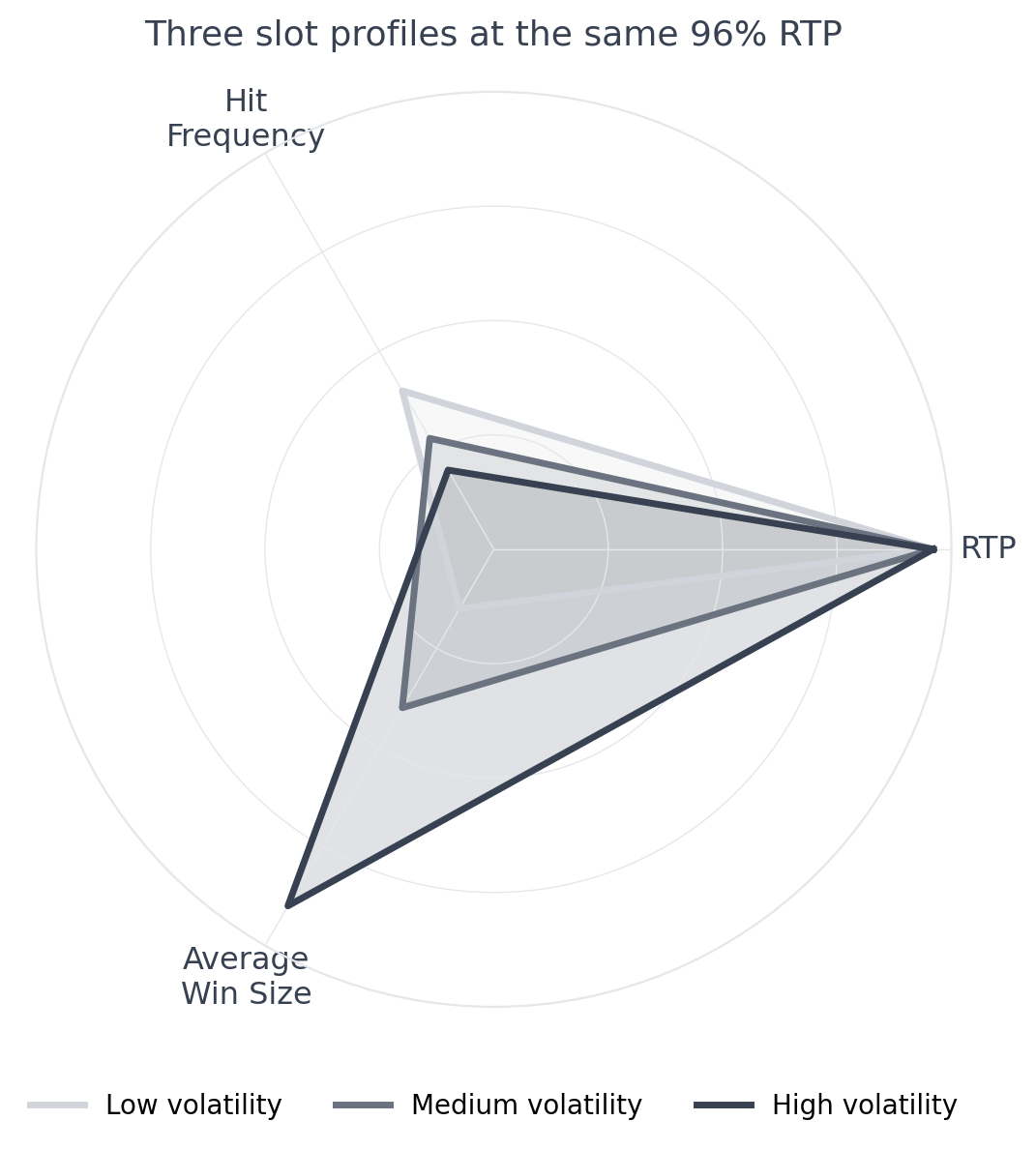
Volatility describes the pattern of a slot’s payouts rather than the total. Two slots at the same 96 percent RTP can produce radically different session experiences depending on how the winnings are distributed.
Low volatility slots pay small amounts frequently. Your balance rises and falls gently, big wins are rare, and sessions can run for hundreds of spins on a modest bankroll. Book of Ra Classic and Starburst are canonical examples of the format.
High volatility slots go the other direction. Long dry spells punctuated by occasional big wins are the pattern, and the same bankroll runs through spins much faster. Bonanza and Dead or Alive 2 are the well-known high-volatility titles.
Medium volatility is where most modern slots sit. It balances hit frequency against payout size and is the commercial sweet spot for operator engagement.
Hit Frequency: How Often the Reels Actually Line Up
Hit frequency is the simplest of the three numbers. It is the percentage of spins that produce any win at all, regardless of size. A 30 percent hit frequency means that roughly one spin in three produces a payout of some kind.
Modern video slots typically run hit frequencies between 20 and 40 percent. Low-volatility slots sit at the higher end, high-volatility slots at the lower end. Neither is inherently better than the other because hit frequency and win size trade off against each other at any given RTP.

The common confusion is that hit frequency and RTP are the same thing. They are not: a slot with 35 percent hit frequency does not have 35 percent RTP. The two numbers measure different things, and RTP measures return per pound wagered while hit frequency measures how often something happens per spin.
How the Three Numbers Interact in Practice
The four common combinations of the three numbers, with the practical experience each produces:
- High RTP + high volatility. Rare big wins with long dry stretches between. Requires a bigger bankroll and patience. Best for players who want the chance at a life-changing hit and can handle the volatility to get there.
- High RTP + low volatility. Frequent small wins with a gently declining balance over time. Good for stretching a modest bankroll and getting long sessions. Best for casual players who value time on the game.
- Low RTP + high volatility. Long dry spells with occasional wins, but overall much worse expected returns. Best avoided unless the slot has a specific bonus or feature worth playing for.
- Low RTP + low volatility. The worst combination. Frequent small wins mask that the balance is grinding to zero faster than the player realizes. Avoid.
The four combinations cover most of what you actually encounter in a modern operator lobby. Knowing which category a slot belongs to before playing it turns the choice from guesswork into a real decision.
What This Means for How to Pick a Slot
The practical takeaway is simple. Check the RTP first because it sets the ceiling on what the slot can return over time. Anything below 94 percent is not worth playing regardless of the other numbers.
Check the volatility second because it determines whether the slot matches your bankroll. High volatility is for bigger bankrolls and patience; low volatility is for longer sessions on smaller stakes; medium is the general default.
Check the hit frequency third because it fine-tunes the experience within the volatility category. A high-volatility slot with 25 percent hit frequency plays differently from one with 15 percent, even though both are technically high volatility.
Read all three together, and the choice becomes obvious in most cases. That is what separates informed play from guessing, and it is the difference between a slot that fits your session and one that does not.
Source link
Online Slot